


Bretz Families of Pennsylania
By Christopher Bretz
This is still a work in progress.
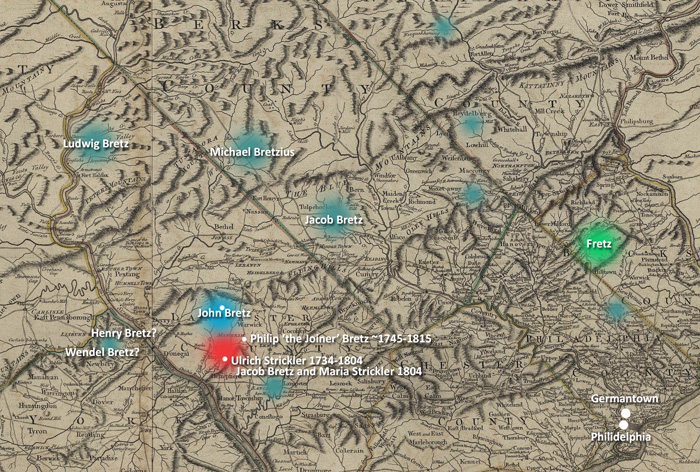
Southeastern Pennsylvania, 1775
Origin of the Bretz Mennonites
From The Mennonite Settlements in Pennsylvania and Waterloo with Special Reference to the Bowman Family, 1922, H M Bowman.
The Home Land and Race of Waterloo County Mennonites [...] The German Swiss, which is the race of most Waterloo Mennonites, belong to the southernmost of the three great tribes, or aggregations of tribes in western Germany, the Saxons at the mouths of the Weser and Elbe in the north, the Franks in the centre, and the Swabians on the upper Rhine. A part of the Saxons in the 5th and 6th centuries crossed the North Sea and occupied England and the south of Scotland. The Franks at about the same time spread into France and gave their name to that country. The racial basis of the Swabian or southern group was the German tribe called at first the Alamanni, i.e. all men, because they were a confederation or rather a fusion of several German peoples. The Alamans or Alamanni proved most formidable enemies to the Romans and Gauls. To this day the French apply the name of this single German tribe to Germans in general (Allemands) and to Germany (Allemagne). The use of the term Swabia (Suabia, Suavia) in connection with the Alaman territory begins with the 5th century, when the Suevi poured into that country and amalgamated with the Alamans. These Suevi were not the Suevi of Caesar and Tacitus who used that term collectively for a great number of German tribes, that later were called by their distinctive names. The later Suevi who united with the Alamans were a body of bold adventurers gathered from various German tribes. They took the ancient Suevic name because they had no tribal name of their own. They were among the most notable peoples that broke up the Roman empire in the west. The Alamans on uniting with them adopted also gradually their name, The modern Swabians occupying approximately Baden, Wuertemberg, northern Switzerland, and part of Bavaria and Alsace, are the direct descendants of this united group. |
The early history of the Mennonite Bretz family line is a bit of a mystery. As noted elsewhere, the vast majority of Bretz families who immigrated to America in the 18th century were Lutherans, and for which there generally are more complete records. There are also very few modern records which point to surviving Pennsylvania Bretz Mennonites, at least as the surname is currently spelled. And as yet no Mennonite ancestors prior to Jacob Bretz (1766-1843) have been identified.
There are several possibilities for this lack of historical evidence;
- The family arrived in America early enough to have not been documented often.
- The family surname used a variant spelling.
- The family adopted the Mennonite faith sometime after their arrival in America as Lutherans.
- Most descendants migrated out of Pennsylvania in early years.
- The family bore a majority of females, thus clouding the historical record.
- They arrived in America by way of another state than Pennsylvania.
- A combination of the above.
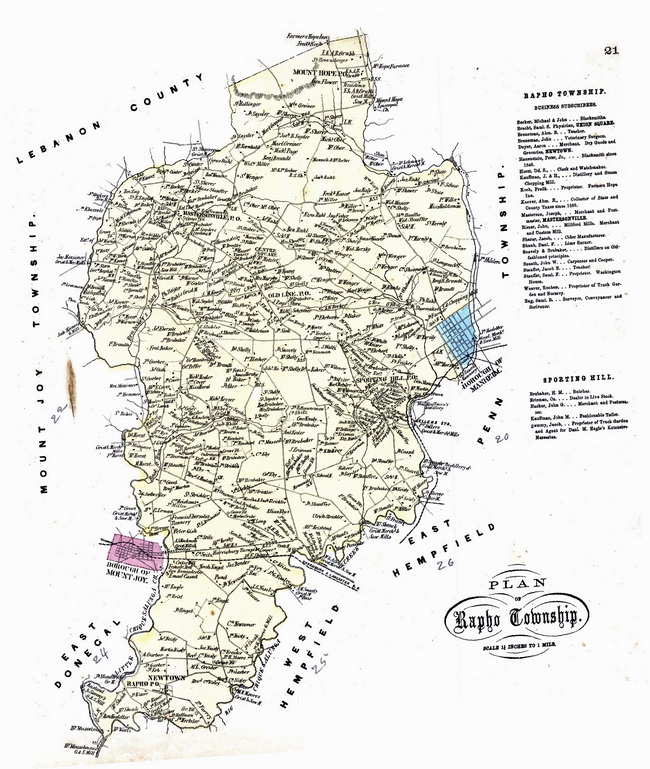
 We do know that the father of the family in Canada, Jacob, was from Lancaster County, Pennsylvania, and that he and his family arrived in the Waterloo area in mid-1806. His wife, Maria Strickler, was from Rapho township where her father and brothers has several farms, demonstrating there must have been some proximity between Maria and Jacob so as to meet. The broader group of Waterloo Mennonites were also led north by the Eby family, and Hans Eby's meeting house (where the decision to move was made) was located in Penn township near Mannheim, only a few miles down the road from Rapho township. All of this implies that at very least our Jacob Bretz was in the vicinity of Rapho by the 1790s.
From Will Abstracts 1729-1819- Lancaster County PA.
STRICKLER, ULRICH Rapho Twp. August 29, 1804 Wife: Elizabeth Strickler. Ex.: John and Henry Strickler. Will Book J, Vol. 1, p. 258 |
Jacob and his wife Maria were documented together on this one record while they were in the United States, the Last Will and Testamant of Maria's father, Ulrich. The full Will record shows that Ulrich was quite a wealthy man and upon his death in 1804 he divided his estate equally between his children. Maria recieved 50 pounds per year for about 10 years (at least $15,000/year in 2012 dollars), and this perhaps financed the family move to Waterloo in the coming years.
Whereas it is unclear what faith the Bretz family followed at this time, the Strickler family were most certainly Mennonites. There is a well documented history of the family going back to Switzerland in the early 17th century, including a minister of the church. Ulrich was fined for refusal to bear arms at Rapho from 1783-1786 with his son John, which would seem to indicate that Ulrich was a pacifist.
It seems plausible that if Jacob Bretz wasn't already a member of the Bretheren, then he converted when he married into the Strickler family.
Emigrants from the Pfalz
In a biographical sketch of Robert Bretz (1860-1944) conducted in 1937, he mentioned that "the German language was retained by the family until the fifth generation in America". Assuming he was referring to his own father's generation - that of Gerhard Bretz, it would suggest the Bretz family arrived prior to around 1740, during the first waves of Mennonite settlement from the Palatinate. The statement incredibly also references two unknown generations before the elder Jacob Bretz for which we have no records. It is unlikely that Robert was referring to himself with this comment. His grandfather, Preacher Jacob Strickler Bretz, does make sense as the focus of the "fourth generation" as he was a Mennonite preacher who in previous years would have still conducted worship in the German language. Robert also confirmed that his family was from Lancaster County.
If this statement is true and the family arrived prior to ~1750, than a few assumptions could help us in our research of this family line;
- The first Bretz family likely settled in the earliest Pennsylvania counties; Montgomery County (called Philadelphia county at that time), Chester County, or Bucks County, as the rest of the state was still wilderness. Lancaster County would not exist until 1729 as a result of the growth brought by the Palatines to Chester County.
- They might have spent time in Germantown near Philadelphia, or the Pequea Colony near Lancaster, the Franconia congregations in Chester County, or the Swamp Church in Bucks County. All among the oldest Mennonist congregations.
- It seems more and more likely to us that the original Mennonite Bretzes went by a variant spelling of the surname given its rarity in the historical record. Pretz, Pratz, Britz, Britzius are distinct possibilities.
- The years 1717-1729 were a major phase of Mennonite immigration, ending with the Naturalization Act.
The earliest ship records we have found which show a similar name to Bretz are of Jacob Pretz (Ratz) in 1732, Jacob and Wilhelm Bretz from 1743, and Philipp Bretz from 1744. However we also know that the Mennonite John and Christian Fretz families came over during the 1710-20s, but there is no record of their journey, so it is also possible this lines ancestors were not recorded.
It does not appear the family was within Lancaster County during the early years. The Naturalization Act of 1729 includes the names of many Mennonite men (some sources say all) dwelling within Lancaster, but not one name is similar to Bretz.
One possible location for early settlement is in Schuylkill township near Phoenixville or Skippach. Many families who would later make the journey to Waterloo hailed from this area, including the Clemens, Bergey. From The Mennonites of America, 1932, C Henry Smith.
In Schuylkill township near what is now Phoenixville a congregation was also early established by
Hans Staufifer, who came to America in 1710, soon after his arrival located near Valley Forge, several miles to the east of Phoenixville. In 1720 Francis Buchwalter, the progenitor of a large family, also settled near here. These were followed by others with such names as Showalter, Bender, Haldeman, etc. By 1750 they were worshiping in a house which was also used by other denominations, but by 1772 they had erected a building of their own. Among their well known ministers were Matthias Pennebeker, the great-grandfather of ex-Governor S. W. Pennypacker. [...] The influence of these early settlements upon the Mennonite church at large has not been small. The Canadian Mennonites came, as we saw, influenced largely from Bucks county. Montgomery, Berks and Bucks counties are also claimed as the original home of many of the Mennonite communities throughout the country. Among the most common names within this district are the following: Funk, Staufer, Godshalk, Ziegler, Clemmer or Clymer, Roth, Bechtel, Boyer, Moyer, Bergey, Detweiler, Hallman, Gehman, Bauman, Kolb, Pennebecker, Frey, Showalter, Kratz, Oberholtzer, Longenecker, Yoder, Hunsicker, Alderfer, Wambold, Haldeman, Fretz, High, Geisinger, Schliefer, Geil, Benner, Heistand, Souder, Allebach and Beidler. Many of these have become familiar throughout various parts of the country both within and without the Mennonite church. |
We have found there are several Bretz families recorded in the Lancaster County area during the late 1700s from tax lists and other documents, including the Pennsylvania Archives, Third Series, Vol XVII, 1897;
John Bretz
Antonius Bretz
Nicholas Bretz
Simon Bretz
Philip Bretz
William Bretz
Benjamin Bretz
William Bretz Junior
Jacob Bretz
Catarina Bretz
John Bretz
|
The family of Philip 'the Joiner' Bretz of Mannheim seems quite promising as a connection to the Bretz Mennonite line. Phillip's children are quite numerous and would have been born around the time when Jacob Bretz first appears in 1766. In fact a Jacob is listed as his eldest son. As well, on the 1790 and 1800 census of Rapho, Philip and his family are found on the same sheet as Ulrich Strickler implying the families lived very close to one another. Although the family was Lutheran, it does not preclude Jacob from converting to Mennonite when he married into the Strickler family.
From Will Abstracts 1729-1819- Lancaster County PA.
BRETZ, PHILIP Manheim Twp. March 10, 1809 Wife: Elizabeth Bretz. Ex.: William Bretz and David Kuentzel. |
 Philip's Will shows that he had remarried after his first wife Catharina had died. His second wife's name was Elizabeth. Children born by his first wife include; Jacob, Catherine, Barbara, Wilhelm, Magdelena, Ann, Maria, and John. The daughter Catherine's birth is thought to be 1769 which would put her older brother Jacob's a few years earlier, and near our Jacob's known birth date of 1766.
Catharina and Philip are also recorded on the birth records of their daughters Barabara and Anna Maria at the Zion Evangelical Church in Manheim.
It has been suggested by some researchers that Philip was the son of Philip Bretz who immigrated in 1744 aboard the ship Phoenix.
The name of Philip Bretz was first recorded being in Rapho township by 1752, as noted in the Old Home Week 1812-1912 Souvenir Book, p. 11. This could have been the Joiner's father as he himself would have only been a teenager. There are also several Bretz' in the records of Rapho who remain unconnected as yet. Simon Bretz bought land in 1765 which would make him a possible contemporary of the Joiner. A brother perhaps? As well there is a Nicholas Bretz from a 1779 tax roll. They do not seem to be related to John Bretz the Lutheran.
Philip's daughter, Catherine Bretz would also marry David Kinsey in 1790 at the First Reformed Congregation at Lancaster. He was the son of a Swiss family of early immigrants who identified as Tunkers. This is the first piece of circumstantial information we have to say the Philipp's family might not have been exclusively Lutheran or Reformed. It appears David is listed on father-in-law Philip's will as an executor (David Kuentzel).
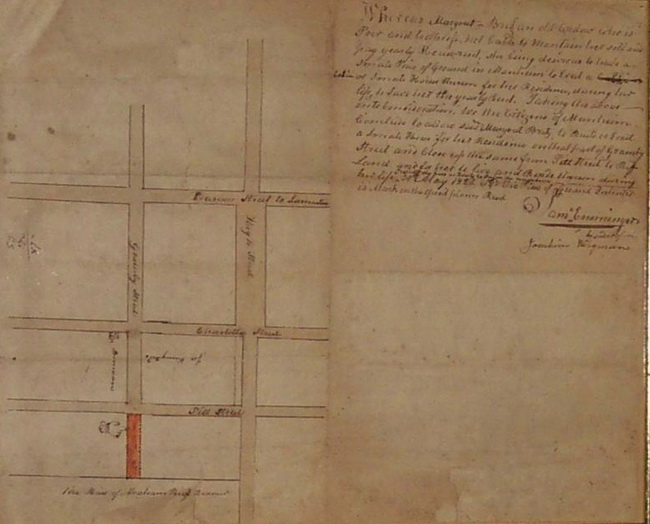
There is also a record of an elderly Margaret Bretz of Manheim from 1822 who could be one of Philip's daughters by his first wife, or the widow of one of his sons. There are no other Margaret's, either by marriage of by birth which we have yet found which fit this time and place. It is a sad story, and would seem to imply that she had no other family around Manheim to aid her. From the Historic Manheim Preservation Foundation, 2007.
The piece of ground indicated is marked on the aforesaid planes read. Samuel Ensminger |
J Harlen Bretz also noted Phillip the Joiner while trying to reconcile his own Lutheran family line for John Bretz of Rapho;
| Among John’s sons was a Philip, a John, Jr., a Jacob and an Anthony, all names appearing in the Pennsylvania records. Of those four, a birth date is known only for Philip; 1765 and John; 1768. Philip was therefore eight years old when Philip, the joiner, appeared in the record and only 16 when Sergeant Philip was first recorded in the Continental Army. He was not the joiner and very probably he was not the sergeant. |
Sergeant Philip Bretz was recorded in;
| Captain Noah Ceasey’s company, 7th battalion of the Lancaster County Militia, 1781,1782,1783. Captain George Gantze's company, 4th battalion of the Lancaster County Militia, 1784. |
If he were the same person as Philip the Joiner, then the Sergeant would have been in his 40s when he served. This is a slightly problematic connection as it seems unlikely that a Mennonite man would serve in the Continental Army.
The US census records there was a group of Bretz families in Rapho township starting in the 1810s and present there until the 1850s. William Bretz and his two sons, William Jr and Benjamin, all raised their families in roughly the same location as Philip Bretz had a few years earlier. Checking each decade of the census, the local surnames all remain relatively constant over time, including of the Strickler family, and this implies that William might be Philip the Joiner's son. William was a blacksmith and appears to have taught his trade to his son Benjamin. William Jr was a wagonmaker. After the death of William Sr in 1851, the families appear to have moved to Ohio.
...
One of the few modern family lines of Bretz Mennonites surviving in Pennsylvania might be the descendants of Thomas F Bretz (1873-1957) of Lancaster County. His grandchildren are buried in the Risser Mennonite Cemetery. Unfortunately his father appears to have died when he was young and we haven't been able to connect this branch further.
Families which ended up with the Bretzes in Waterloo could also help provide clues as to the Mennonite Bretz origins. However it has to be said we have yet to find a Bretz surname on any old Mennonite list.
Gingerich: Alsace. The first record of the surname in America is in Conestoga Township, Lancaster County, Pennsylvania in 1724, where the name of William Gingerick appears. In 1727 three men came to America: Christian, Jacob, and David Gingrich. They served in Chester Co. Pennsylvania as indentured servants. Johann Gingerich appears in 1735 in Warwick Township, Lancaster County PA. Ulrich Gingerich, emigrated from Alsace to Lancaster County Pennsylvania in 1747.
Clemens: German. In 1709, the Clemens family were part of the Ibersheim Congregation that lived on Farm 2 at Dittelsheim, Germany. The Clemenses left their home in November 5, 1709, and after about 10 weeks of travel they arrived in London, England on January 26, 1710. They sailed on the "Marie Hope" and after 67 days at sea they reached Pennsylvania where the settled in the Skippach area, and later Salford township.
Strickler: Swiss.
Bergey: Swiss. Most of the Bergeys now living in the United States and Canada are descendants of John Ulrich Bergey and his wife, Mary, who settled in what is now Montgomery County, Pennsylvania. It is believed that he came from Switzerland in 1719. They were Mennonites. He was one of the originators of the Mennonite congregation in Salford in 1738.
The Bretz and Boyer Family
The descendants of John Wendel Bretz. From Notes and Queries: Chiefly Relating to Interior Pennsylvania, Volume 1, p 113
| The grandfather of Mr Bretz [Boyer side] resided near Bethlehem, Pennsylvania, where he had located at an early period. During the Indian War, he was killed in his field by the savages and his wife in the house, while a son and a daughter were taken captive. The latter married an Indian and remained among the red men; the former, after seven years captivity was returned to Philadelphia with other prisoners, and sent to Reading. Here Mr Boyer married and lived to a ripe old age. He left four children: John Valentine, Catherine, Elizabeth, Mary Ann (m. Jacob Bretz). |
The Bretz and Greiner Family
The Bretz and Grenier families intermarried extensively. The Greiner family also had dealings around Rapho township. From the research of Robert Greiner.
The Greiner family emigrated sometime in the 1730s from Meckesheim, Germany.
The son, Valentine Greiner married Anna Barabara Bretz around 1747. The surname of Valentine's wife Barbara had been the source of some confusion in the past. However, her maiden name was found in Bible records of their daughter Anna Barbara Fishburn.
- Their son, Philip Greiner, married Barbara Fishburn, the daughter of John Philip Fishburn and Catherine Elizabeth Bretz. 1768
- Their son, Martin Greiner, married Margarette Fishburn, the daughter of John Philip Fishburn and Catherine Elizabeth Bretz. 1774 Stayed in Rapho
- Their daughter, Anna Barbara b. 1759, married John Fishburn, the son of John Philip Fishburn and Catherine Elizabeth Bretz. 1779
- Their son, John Greiner, married Anna Marie Fishburn, the daughter of John Philip Fishburn and Catherine Elizabeth Bretz. 1786
Possibly the elder women Anna Barbara and Catherine Elizabeth were sisters, meaning the children were cousins? Some researchers claim Catherine was from Volxheim.
The approximate birth years of the elder women (1720s) could imply they are sisters to Philip Bretz who emigrated on the Phoenix in 1744.
Origins of the Bretz Lutherans
Many of the more well known Bretz family lines in Pennsylvania came from the Lutheran faith.
Ludwig Bretz
Henry Bretz
Wendel Bretz
Johannes Bretz's family is first found in Rapho township
More coming...
Locations in Germany where Bretz Immigrants came from
Many of the Bretz immigrants from the 18th century all came from the same small area of southern Germany, around the town of Bad Kreuznach. Some of the known locations include;
Volxheim, Bad Kreuznach, Rhineland-Palatinate, Germany
Bretzenhiem, Bad Kreuznach, Rhineland-Palatinate, Germany
Furfeld, Bad Kreuznach, Rhineland-Palatinate, Germany
Darmstadt, Hessen, Germany
around Mannheim, Germany
Meckesheim, Baden, Germany
Welgesheim, Mainz-Bingen, Rheinland-Pfalz, Germany
American Bretz descendant locations